Economic Order Quantity: The Cheapest Batch to Buy
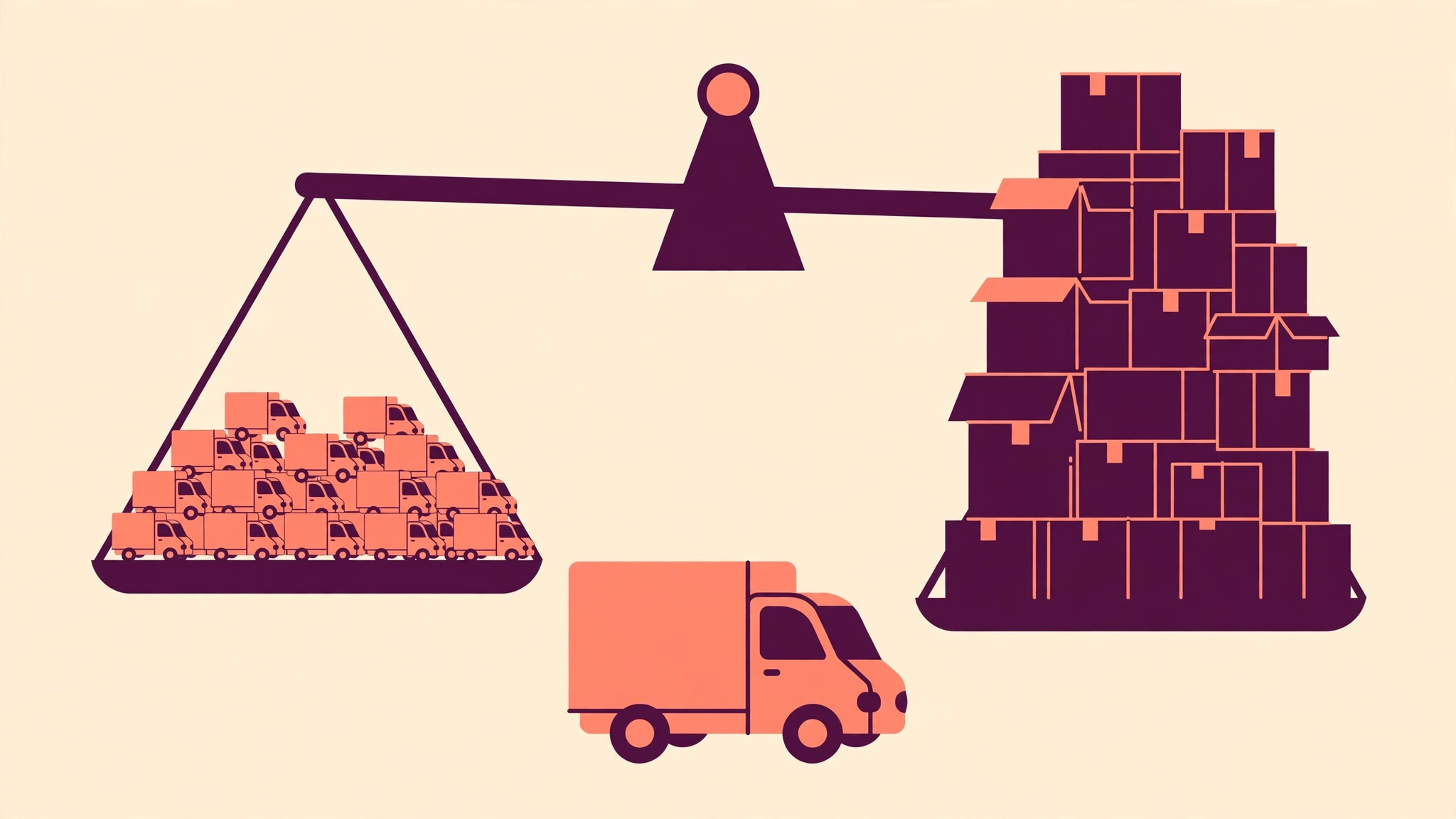
The balance point
Order in small batches and you pay ordering costs again and again: administration, delivery, inspection. Order in bulk and those costs fade, but the warehouse fills with stock that must be stored, insured, financed and eventually perhaps written off. The economic order quantity is the batch size where the two cost families cross at their lowest total. Its formula, the square root of twice the annual demand times the cost per order, divided by the holding cost per unit per year, has been used for over a century because the trade-off it describes never goes away.
A worked feel for it
A business using 12,000 units a year, paying 100 per order and 2 per unit per year to hold stock, has an EOQ near 1,095 units, about eleven orders a year. Doubling the order cost pushes the EOQ up by only about 41 percent, because of the square root: the formula is forgiving, and being roughly right matters far more than being exactly right. That forgiveness is practical gold: round the answer to a convenient pack size or a full pallet without a second thought. The total cost curve around the EOQ is reassuringly flat, which is the formula's hidden kindness. Ordering 20 percent too much or too little raises the combined ordering and holding cost by only a few percent. Precision matters far less than being in the right neighbourhood and reviewing the inputs when demand or costs shift materially. A business that recalculates EOQ annually and acts roughly on it beats a business with a perfect figure from five years ago.
Beyond the formula
EOQ assumes demand is steady, lead times are known and prices do not change, and real life violates all three politely. So EOQ is the starting point, adjusted by reorder point logic for lead time, safety stock for variability, and commercial sense for quantity discounts, where a price break can justify a deliberately larger order. Perishables, fashion and anything with an expiry date override the formula entirely: the cheapest order quantity is worthless if the last third of the batch is thrown away. Do not forget the demand figure's own trap: it must be the demand for the planning period at the expected rate, not last year's flattered by a one off contract or depressed by a stockout. EOQ built on a distorted demand calmly optimises the wrong world. Pair it with the reorder point, which handles the timing of each order, and the pair covers the two questions inventory control actually asks: how much, and when.